iranbroker
two redesigns, one design system, a new kind of user
A technical constraint said: change the UI, nothing underneath it. I turned that constraint into a design system and a new kind of user.
- role
- Product Designer
- timeline
- 2024 — Present
- team
- In-house product team
overview
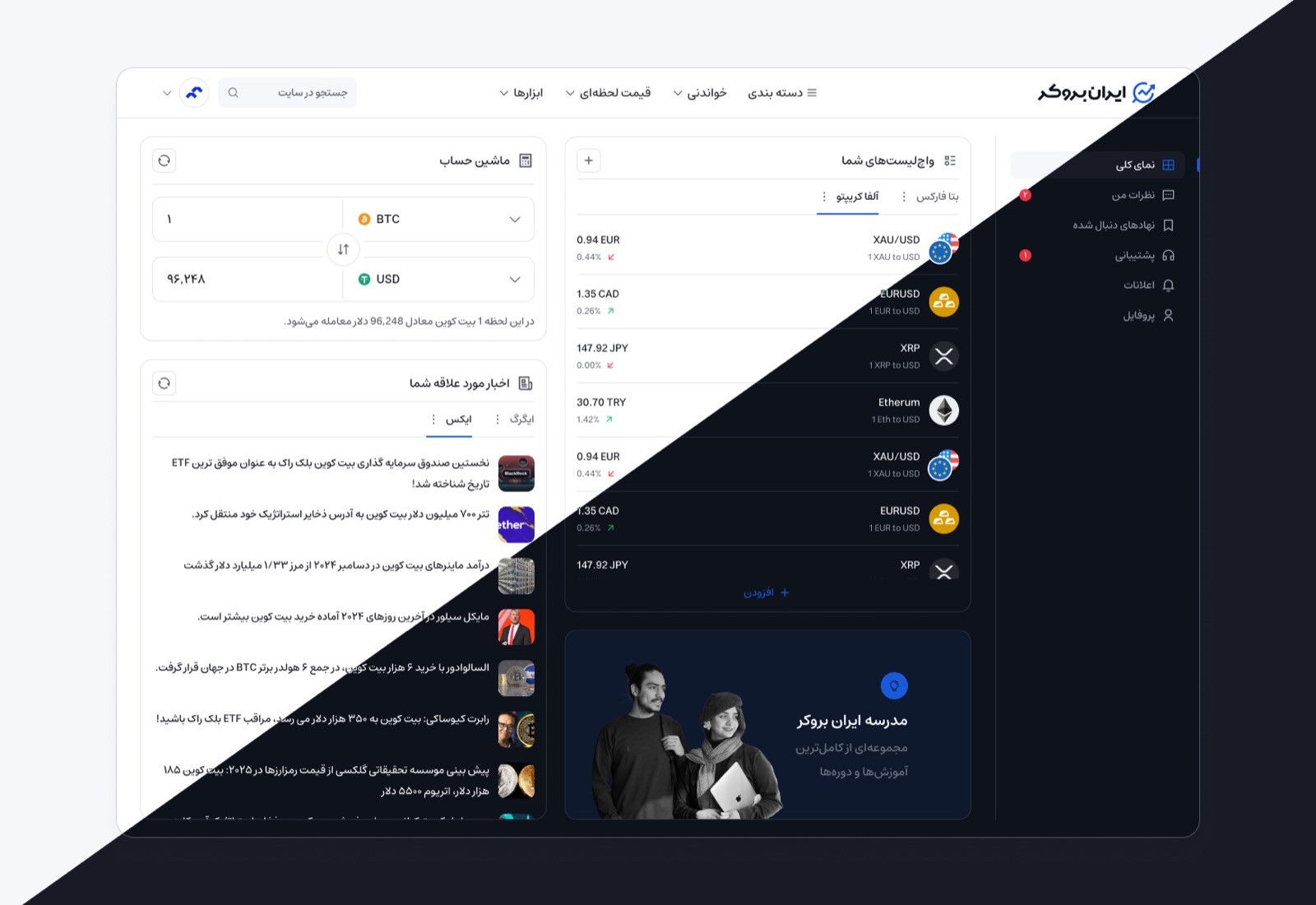
At IranBroker, a platform for researching and comparing financial brokerages, I led two consecutive product redesigns: v2, which brought the legacy system up to date visually and in UX, and v3, which took the product further by building a unified design system, running exploratory research with 20 to 30 traders, and designing a dashboard for financial institutions.

The problem
When I joined IranBroker, the team was mid-migration from v1 to v2 — a mid-scale redesign meant to move the product past an outdated system and visual language, not rewrite the information architecture from scratch. The migration came with real technical constraints: the redesign had to happen mostly at the UI layer, not in the underlying architecture.
As the product designer, I decided to treat that constraint as an opportunity. Instead of designing from zero, I focused on getting the fundamentals of the user experience right and landing a coherent UI kit across the whole site. Along the way I found and fixed several parts of the system that had effectively stopped working — not as a separate project, but as a natural part of any redesign that actually follows the user's real path.


What I found
To understand what Iranian traders actually needed, I designed and ran an exploratory study for v3: a survey paired with in-depth interviews across 20 to 30 traders from different market segments. What came out of it shaped every later decision on the user dashboard — including the decision to design a dashboard that, for the first time, brought financial institutions onto the platform as their own user type, not just individual traders.
What I designed
V3 ran on three parallel tracks I pushed forward at the same time. As the design-system designer, I built a unified design system for IranBroker and rolled it out across the whole site as I built it — the redesign and the design system weren't two separate phases, they were one process, and new features took shape inside that same process.
Building on the same research, I designed a dashboard for financial institutions that let them use IranBroker's features and services at an organisational scale — a product the platform had never had before.
Outcome
V3 took IranBroker from an updated UI kit to a product with one unified design system, and for the first time brought financial institutions onto the platform as their own user type.
- one unified design systemthe v3 infrastructure
built and rolled out across the whole site at the same time — not two separate phases
- 20 to 30 tradersthe depth of the exploratory research
a survey plus in-depth interviews across different market segments, feeding directly into dashboard decisions
- institutional dashboard activation ratethe metric I track
the share of institutions that actually use the dashboard after seeing it — the honest test of whether this new user type stuck
what i'd do differentlyThe tradeoff I'd revisit: I'd run the exploratory research with traders earlier — alongside the start of v2, not only ahead of v3. Some of v2's surface-level decisions could have taken direction from those same findings instead of leaning on UX fundamentals alone.